
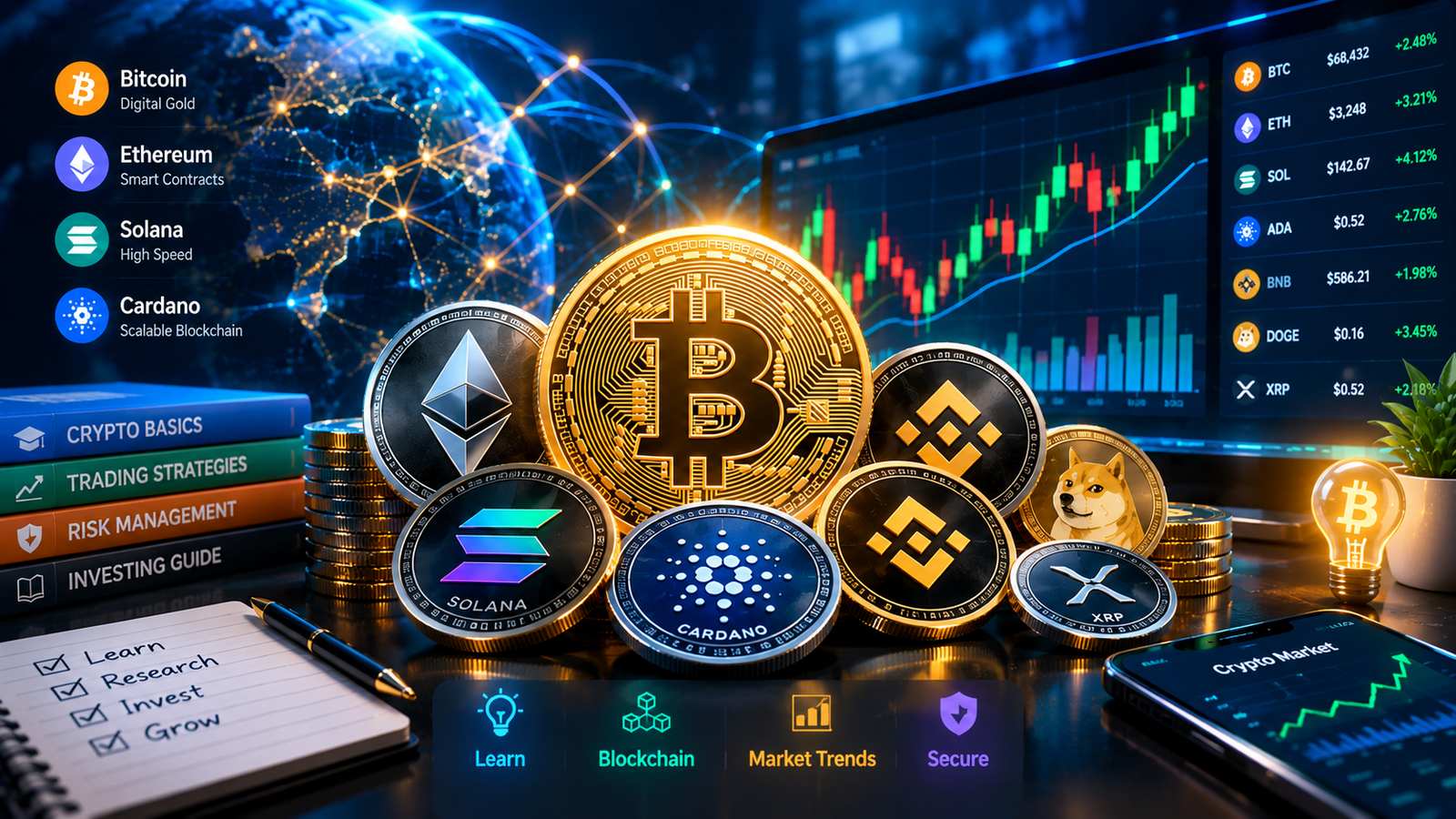
The cryptocurrency market has become one of the most discussed areas of the digital economy. From Bitcoin to thousands of alternative cryptocurrencies, digital assets have created new opportunities for people interested in blockchain technology and online finance. However, for beginners, the large number of cryptocurrencies, technical terms, price charts, and market updates can make the industry difficult to understand.
Understanding Bitcoin and altcoins for beginners entering cryptocurrency markets starts with learning the basic differences between major cryptocurrencies, how blockchain technology works, what influences prices, and what risks investors should consider.
This guide explains Bitcoin and altcoins in simple language and provides a foundation for anyone who wants to learn more about the cryptocurrency market.
What Is Bitcoin?
Bitcoin is the first widely recognized decentralized cryptocurrency. It was introduced in 2009 and operates using blockchain technology rather than relying on a traditional central bank to manage transactions.
Bitcoin allows users to transfer value through a decentralized network. Transactions are recorded on a public blockchain, providing a transparent record of activity.
One of Bitcoin’s most important characteristics is its limited supply. The Bitcoin protocol has a maximum supply of 21 million coins. This limited supply is one reason Bitcoin is often described as a scarce digital asset.
Bitcoin can be used for different purposes, including transferring value, holding digital assets, and participating in the broader cryptocurrency ecosystem.
What Are Altcoins?
The term altcoin generally refers to cryptocurrencies other than Bitcoin. Some altcoins were created to provide different features, technologies, or use cases compared with Bitcoin.
There are thousands of digital assets in the cryptocurrency market, and they can differ significantly in their purpose and technology.
Some altcoins focus on smart contracts, decentralized finance, payments, gaming, digital applications, or blockchain infrastructure.
Examples of well-known cryptocurrencies outside Bitcoin include Ethereum, Solana, Cardano, and other blockchain-based assets. Each project has its own network, technology, token economics, and ecosystem.
Bitcoin vs Altcoins
Understanding the difference between Bitcoin and altcoins is an important first step for cryptocurrency beginners.
Bitcoin was designed primarily as a decentralized digital form of value and a peer-to-peer payment system. Many altcoins, on the other hand, were created with additional functionality or specialized purposes.
For example, some blockchain networks allow developers to create decentralized applications and smart contracts. Other projects focus on improving transaction speed, reducing fees, supporting gaming ecosystems, or providing blockchain infrastructure.
The cryptocurrency market is therefore not one single technology. Different projects can have completely different goals.
How Does Bitcoin Work?
Bitcoin uses blockchain technology to record transactions. A blockchain is essentially a distributed digital ledger maintained across a network of computers.
When a Bitcoin transaction takes place, it is broadcast to the network. Transactions are then processed and recorded according to the Bitcoin protocol.
Bitcoin uses a consensus mechanism called proof-of-work. Participants known as miners use computing power to help secure the network and process transactions.
This decentralized structure means that Bitcoin does not depend on a single company or institution to maintain its transaction history.
How Do Altcoins Work?
Altcoins use different technologies and consensus mechanisms depending on the project.
Some use proof-of-stake, while others use alternative approaches to achieving network consensus. Certain cryptocurrencies operate on their own blockchains, while others exist as tokens on established blockchain networks.
For beginners, it is not necessary to understand every technical detail immediately. However, learning whether an asset has its own blockchain, what its purpose is, and how its network operates can help investors conduct better research.
Why Do Bitcoin and Altcoin Prices Change?
Cryptocurrency prices can be highly volatile. Prices may rise or fall because of a combination of market and external factors.
Important factors include:
- Supply and demand
- Investor sentiment
- Market liquidity
- Economic conditions
- Regulatory developments
- Technological upgrades
- Institutional interest
- Cryptocurrency adoption
- Exchange activity
- Major industry announcements
News can also have a significant impact on market sentiment. Positive developments may increase demand, while negative announcements can create selling pressure.
However, a price increase does not necessarily mean that a cryptocurrency has strong long-term fundamentals. Similarly, a price decline does not automatically mean that a project has failed.
Understanding Bitcoin Market Trends
Bitcoin often plays an important role in the overall cryptocurrency market. Because of its large market capitalization and popularity, Bitcoin price movements can influence investor sentiment across the industry.
When Bitcoin experiences strong upward or downward movement, many altcoins may also react.
Beginners should therefore pay attention to broader market conditions rather than analyzing an individual altcoin in isolation.
Market trends can be studied using historical price data, trading volume, market capitalization, technical indicators, and fundamental developments.
Understanding Altcoin Market Trends
Altcoin markets can behave differently from Bitcoin. Some altcoins experience significant price movements during periods of strong market enthusiasm.
However, smaller cryptocurrencies can also have lower liquidity and higher volatility.
Before researching an altcoin, beginners should consider questions such as:
- What problem does the project solve?
- What technology does it use?
- Who is developing the project?
- Does the project have real-world use cases?
- How is the token distributed?
- What is the total token supply?
- How active is the development community?
- Is there sufficient market liquidity?
- Does the project have a transparent roadmap?
These questions can help distinguish a project with a meaningful use case from one based primarily on speculation.
What Is Cryptocurrency Market Capitalization?
Market capitalization is one of the commonly used metrics for comparing cryptocurrencies.
It is generally calculated by multiplying the current price of a cryptocurrency by its circulating supply.
For example:
Market Capitalization = Current Price × Circulating Supply
Market capitalization can provide useful context when comparing digital assets. However, it should not be the only factor used when evaluating a cryptocurrency.
A cryptocurrency with a low price per coin is not necessarily cheaper or more valuable than one with a higher price. The total supply of the asset must also be considered.
Bitcoin and Altcoin Investment Strategies
There is no single strategy that works for everyone in the cryptocurrency market. Different investors may have different goals, time horizons, and risk tolerances.
Some market participants focus on long-term investing, while others use short-term trading strategies.
Long-term investors may research the technology, adoption, development activity, and long-term potential of a cryptocurrency.
Short-term traders may focus more heavily on price charts, market momentum, volume, and current market conditions.
Beginners should first focus on education and risk management instead of trying to make quick profits.
Why Cryptocurrency Research Is Important
The cryptocurrency industry contains both established projects and highly speculative assets. This makes research especially important.
Before considering a cryptocurrency, beginners should review reliable information about its technology, development team, tokenomics, supply structure, and use case.
It is also useful to compare information from multiple sources rather than relying on a single social media post or online prediction.
Promotional content should be treated carefully because projects may present information in a way designed to attract investors.
Common Cryptocurrency Mistakes Beginners Make
New investors can make mistakes when they enter the cryptocurrency market without understanding volatility and risk.
One common mistake is buying a cryptocurrency simply because its price has increased rapidly.
Another mistake is believing that a very low-priced coin automatically has greater potential. The number of tokens in circulation can make a major difference to a cryptocurrency’s market capitalization.
Other common mistakes include:
- Investing based on social media hype
- Ignoring project fundamentals
- Using excessive leverage
- Investing money needed for essential expenses
- Failing to secure cryptocurrency wallets
- Expecting guaranteed profits
- Making emotional decisions during market volatility
Learning from these mistakes can help beginners approach the market more responsibly.
Bitcoin and Altcoin Security
Security should be a major priority for anyone using cryptocurrency.
Cryptocurrency wallets allow users to manage their digital assets and private keys. Depending on the wallet type, users may have different levels of control over their funds.
Beginners should use strong passwords, enable available security features, and be extremely careful with suspicious links and messages.
Private keys and recovery phrases should never be shared with strangers. Anyone who obtains access to sensitive wallet credentials may potentially gain control over the associated assets.
Scammers can also use fake websites, impersonation, phishing messages, and fraudulent investment opportunities to target cryptocurrency users.
Long-Term Potential of Bitcoin
Bitcoin continues to attract attention because of its decentralized design, limited supply, global accessibility, and established network.
Its future development may be influenced by adoption, regulation, technological improvements, institutional participation, and broader economic conditions.
However, future performance cannot be guaranteed. Bitcoin remains a volatile digital asset, and investors should understand that prices can move significantly in either direction.
Long-Term Potential of Altcoins
Altcoins provide a broader range of blockchain technologies and applications. Some projects aim to improve scalability, decentralized applications, financial services, gaming, digital identity, or other areas.
The potential of an altcoin depends heavily on factors such as adoption, development activity, network usage, competition, token economics, and the ability of the project to deliver its intended use case.
Some projects may grow significantly, while others may lose relevance or fail to achieve their goals.
This is why beginners should evaluate each cryptocurrency individually rather than assuming that every altcoin will perform similarly.
Bitcoin and Altcoins: What Should Beginners Learn First?
Beginners entering the cryptocurrency market should build their knowledge gradually.
A useful learning path can include:
Step 1: Learn Blockchain Basics
Understand what blockchain technology is and how decentralized networks record transactions.
Step 2: Understand Bitcoin
Learn why Bitcoin was created, how its network operates, and what makes its supply different from traditional currencies.
Step 3: Learn About Altcoins
Explore different types of cryptocurrencies and understand why they were created.
Step 4: Study Market Fundamentals
Learn about market capitalization, liquidity, trading volume, supply, demand, and volatility.
Step 5: Research Individual Projects
Before considering an asset, investigate its technology, team, tokenomics, development activity, and use case.
Step 6: Learn Risk Management
Understand that cryptocurrency investments can lose value and that there are no guaranteed returns.
The Role of Crypto News and Analysis
Following cryptocurrency news can help investors understand developments affecting Bitcoin and altcoins.
Important news categories include blockchain upgrades, regulatory announcements, exchange developments, adoption news, institutional activity, security incidents, and major project announcements.
However, headlines should not automatically become investment decisions.
A responsible approach is to read the news, verify important claims, research the underlying project, and consider the wider market environment before reaching conclusions.
Frequently Asked Questions
Is Bitcoin an altcoin?
No. The term altcoin generally refers to cryptocurrencies other than Bitcoin. Bitcoin is usually treated as a separate category because it was the first major cryptocurrency and has a unique position within the market.
Are altcoins riskier than Bitcoin?
Many altcoins can be more volatile than Bitcoin, particularly smaller projects with lower liquidity and shorter operating histories. However, risk varies significantly between individual cryptocurrencies.
Should beginners start with Bitcoin or altcoins?
Beginners should first learn how cryptocurrency works and understand the risks involved. Bitcoin is often a useful starting point for learning about blockchain and digital assets before exploring more complex projects.
Why do altcoins follow Bitcoin?
Bitcoin has a large influence on overall cryptocurrency market sentiment. When Bitcoin moves significantly, traders and investors may adjust their positions across other digital assets, which can cause altcoin prices to move as well.
How can beginners research an altcoin?
Beginners can examine a project’s official documentation, technology, development activity, token supply, use case, community, market liquidity, and competitive position. Information should be verified using multiple reliable sources.
Can cryptocurrency prices be predicted accurately?
No method can reliably predict cryptocurrency prices with certainty. Technical analysis and fundamental research can help investors understand market conditions, but unexpected events can cause rapid price changes.
Final Thoughts
Understanding Bitcoin and altcoins for beginners entering cryptocurrency markets requires patience, research, and a willingness to learn. Bitcoin provides an important introduction to decentralized digital assets, while altcoins demonstrate the broader possibilities of blockchain technology.
The cryptocurrency market can offer interesting technological developments and investment opportunities, but it also involves substantial risks and volatility. Beginners should avoid making decisions based solely on hype, social media predictions, or short-term price movements.
Instead, focus on understanding blockchain technology, researching individual projects, learning about market fundamentals, protecting digital assets, and practicing responsible risk management.
The more knowledge you develop, the better prepared you can be to evaluate Bitcoin and altcoins and understand the constantly changing cryptocurrency landscape.
Disclaimer: This article is for educational and informational purposes only. It does not constitute financial, investment, or trading advice. Cryptocurrency markets are volatile, and you should conduct your own research and consider your risk tolerance before making financial decisions.