
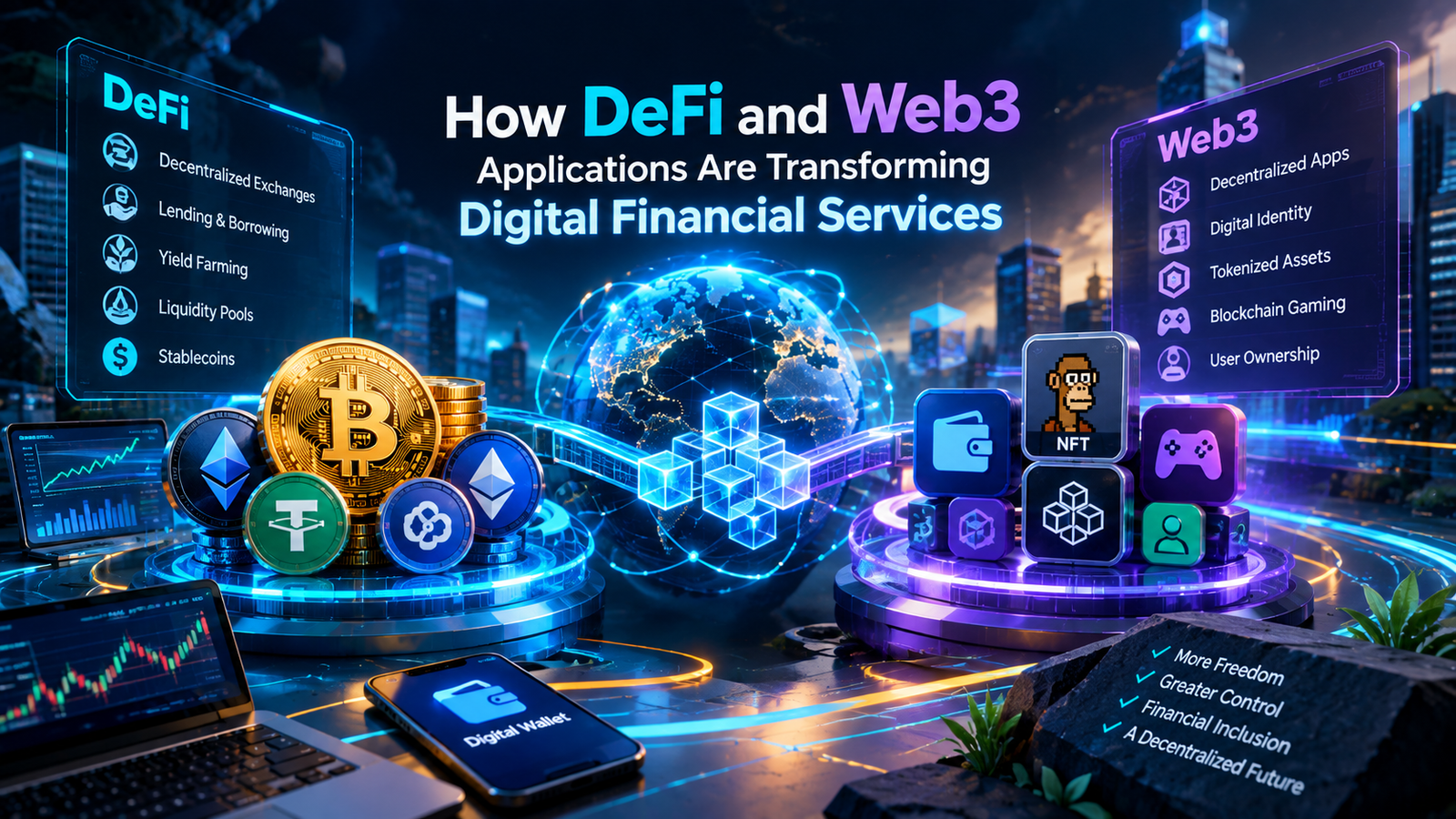
The digital financial landscape is changing rapidly as blockchain technology introduces new ways to manage money, access financial services, and interact with digital assets. Two of the most important developments in this transformation are Decentralized Finance (DeFi) and Web3.
Traditional financial services generally depend on banks, payment providers, brokers, and other centralized institutions. DeFi and Web3 applications attempt to provide alternative systems where blockchain networks and smart contracts can automate financial activities and give users greater control over digital assets.
Understanding how DeFi and Web3 applications are transforming digital financial services can help beginners, investors, developers, and technology enthusiasts understand one of the fastest-growing areas of the blockchain industry.
What Is DeFi?
DeFi stands for Decentralized Finance. It refers to financial applications and services built primarily on blockchain networks.
Unlike traditional finance, many DeFi applications are designed to operate without a central intermediary controlling every transaction. Smart contracts can automatically execute predefined rules when certain conditions are met.
DeFi applications can provide services such as:
- Decentralized exchanges
- Cryptocurrency lending
- Borrowing platforms
- Digital asset trading
- Liquidity provision
- Stablecoin applications
- Yield-generating protocols
- On-chain financial management
Users can interact with these applications through cryptocurrency wallets and blockchain networks.
What Is Web3?
Web3 is a broader concept that describes a more decentralized and user-controlled internet powered by technologies such as blockchain, smart contracts, digital assets, and decentralized applications.
Traditional internet services often depend heavily on centralized companies and platforms. Web3 applications aim to give users greater control over digital identities, assets, and online interactions.
Web3 can include:
- Decentralized applications
- Blockchain-based identity systems
- Digital ownership
- Smart contracts
- Decentralized communities
- Tokenized assets
- Blockchain gaming
- Decentralized finance
DeFi can therefore be considered one important part of the broader Web3 ecosystem.
How DeFi Is Different From Traditional Finance
Traditional financial systems typically rely on centralized institutions to manage transactions and provide services.
For example, when someone wants to borrow money through a traditional financial institution, the institution may evaluate the person’s application, manage the loan, and establish the terms.
In DeFi, smart contracts can automate many financial processes. Instead of relying entirely on a central institution, users interact with blockchain-based protocols.
This can potentially create financial services that operate continuously and are accessible through an internet connection.
However, decentralized systems also introduce new risks, including smart contract vulnerabilities, market volatility, and the responsibility of managing private keys.
The Role of Smart Contracts
Smart contracts are one of the most important technologies behind DeFi and Web3.
A smart contract is a blockchain-based program designed to execute specific instructions when predetermined conditions are met.
For example, a DeFi smart contract could manage the rules of a lending protocol. When users deposit digital assets, the protocol can record those deposits and apply its predefined rules automatically.
Smart contracts can reduce the need for manual processing and allow applications to operate according to transparent rules.
However, smart contracts are software, and software can contain bugs or vulnerabilities. Users should therefore research protocols carefully before interacting with them.
Decentralized Exchanges
Decentralized exchanges, commonly called DEXs, are blockchain-based platforms that allow users to trade digital assets without relying on a traditional centralized exchange in the same way.
Many DEXs use automated market maker systems and liquidity pools to facilitate trades.
Users can connect compatible cryptocurrency wallets and interact directly with the decentralized application.
Potential advantages include:
- Direct wallet interaction
- Transparent blockchain transactions
- Access to a wide range of tokens
- Reduced dependence on centralized intermediaries
However, decentralized exchanges can also involve risks such as smart contract vulnerabilities, low liquidity, token scams, and price slippage.
DeFi Lending and Borrowing
Lending and borrowing are major use cases within decentralized finance.
DeFi lending protocols allow users to deposit digital assets into liquidity pools. Other users may borrow assets according to the protocol’s rules and collateral requirements.
This creates a system where financial transactions can be managed through blockchain-based smart contracts.
One important difference is that DeFi lending commonly uses cryptocurrency collateral. Borrowers may need to provide assets worth more than the amount they want to borrow.
This helps protocols manage some of the risks associated with highly volatile digital assets.
Stablecoins and Digital Payments
Stablecoins are digital assets designed to maintain a relatively stable value compared with more volatile cryptocurrencies.
They play an important role in DeFi because they can provide users with a digital asset that is intended to reduce exposure to price fluctuations.
Stablecoins can be used for:
- Digital payments
- Trading
- DeFi lending
- Liquidity pools
- Cross-border transfers
- On-chain settlements
The design and backing of each stablecoin can differ, so users should understand how a particular stablecoin works before using it.
Web3 and Digital Ownership
One of the major ideas behind Web3 is digital ownership.
Blockchain technology can allow users to hold digital assets in wallets that they control. These assets may represent cryptocurrencies, tokens, digital collectibles, or other forms of blockchain-based ownership.
This model can change how people interact with online platforms.
Instead of an asset existing entirely inside one company’s database, blockchain technology can provide a public record of ownership that can potentially be verified across compatible applications.
Web3 Applications Beyond Finance
Web3 is not limited to financial services.
Developers are building blockchain-based applications for different industries and use cases, including:
- Gaming
- Digital collectibles
- Creator platforms
- Decentralized communities
- Identity systems
- Supply chain applications
- Digital marketplaces
- Tokenized real-world assets
This broader ecosystem demonstrates why Web3 is considered more than simply another form of cryptocurrency technology.
How DeFi and Web3 Improve Accessibility
One potential advantage of blockchain-based financial services is accessibility.
Traditional financial systems may require users to create accounts, complete verification procedures, or meet eligibility requirements before accessing certain services.
Many decentralized applications can instead be accessed through a compatible cryptocurrency wallet.
This can make financial applications available to people who have an internet connection and the necessary digital assets.
However, accessibility does not automatically mean that a service is suitable for everyone. Users still need to understand fees, risks, technical requirements, and local regulations.
Transparency in DeFi
Blockchain networks provide publicly verifiable transaction records.
This can make certain DeFi activities more transparent than traditional systems where users may not have direct access to the underlying transaction infrastructure.
Users can often examine blockchain transactions and interact with protocols through publicly available interfaces.
This transparency can help researchers and developers analyze protocol activity.
At the same time, blockchain transparency does not mean that every DeFi protocol is automatically safe. A transparent smart contract can still contain vulnerabilities or poorly designed mechanisms.
DeFi Risks and Challenges
Despite its potential, decentralized finance has several important risks.
Smart Contract Risk
A programming error or vulnerability can potentially result in financial losses.
Market Volatility
Cryptocurrency prices can change rapidly, which can affect collateral, liquidity, and investment positions.
Liquidity Risk
Some tokens and DeFi markets may have limited liquidity, making large transactions more difficult.
Regulatory Uncertainty
Rules surrounding cryptocurrencies and decentralized financial services continue to evolve in different countries.
User Responsibility
Users may be responsible for protecting their private keys and wallet credentials. Losing access to a wallet can potentially mean losing access to associated assets.
Web3 Security Considerations
Security is especially important when using decentralized applications.
Users should carefully verify website addresses and avoid connecting wallets to suspicious platforms.
Important security practices include:
- Use strong wallet security
- Protect recovery phrases
- Never share private keys
- Verify smart contract interactions
- Research protocols before depositing funds
- Be cautious of unrealistic investment promises
- Avoid suspicious links and unknown applications
No security strategy can eliminate every risk, but careful behavior can reduce exposure to common threats.
Tokenization and the Future of Finance
Tokenization is another area where blockchain technology could influence financial services.
Tokenization involves representing an asset or right through a blockchain-based token.
Potential examples include:
- Digital securities
- Real estate-related assets
- Financial instruments
- Collectibles
- Commodity-linked assets
Tokenization could potentially make certain assets easier to transfer, track, or integrate with blockchain-based applications.
However, legal frameworks, ownership rights, custody, and regulatory requirements remain important considerations.
DeFi and Cross-Border Finance
Blockchain networks can operate globally, making them potentially useful for cross-border financial activity.
Traditional international transfers can involve multiple intermediaries and processing stages.
Blockchain-based transactions can sometimes move digital assets directly between compatible wallets, potentially reducing certain layers of the traditional payment process.
Transaction speed and costs vary significantly depending on the blockchain network and current network activity.
For this reason, users should compare different solutions rather than assuming that every blockchain transaction will be faster or cheaper.
The Growing Web3 Ecosystem
The Web3 ecosystem continues to evolve as developers experiment with new blockchain applications.
DeFi protocols, decentralized exchanges, blockchain games, digital identity systems, and tokenized assets are becoming interconnected through blockchain infrastructure.
This creates the possibility of applications that can interact with one another without requiring every service to operate inside a single centralized platform.
For example, a user could potentially hold digital assets in a wallet and use those assets across multiple compatible applications.
Why DeFi and Web3 Matter for Beginners
Beginners may initially find DeFi and Web3 complicated because they involve unfamiliar concepts such as wallets, blockchain networks, gas fees, smart contracts, liquidity pools, and decentralized applications.
The best approach is to learn the fundamentals gradually.
Start by understanding:
- What blockchain technology does
- How cryptocurrency wallets work
- What smart contracts are
- How DeFi protocols operate
- How decentralized exchanges work
- What stablecoins are
- How transaction fees work
- What security risks exist
Learning these concepts can make the Web3 ecosystem much easier to understand.
DeFi and Web3 Investment Considerations
DeFi and Web3 have attracted significant interest from cryptocurrency investors, but the sector remains highly speculative.
Projects can experience rapid growth, but they can also lose users, liquidity, or market value.
Before considering any DeFi or Web3 project, investors should research:
- Project purpose
- Development team
- Smart contract security
- Tokenomics
- Total and circulating supply
- Liquidity
- Community activity
- Protocol usage
- Revenue model
- Competitive environment
Investors should also avoid assuming that historical performance guarantees future results.
The Future of Digital Financial Services
DeFi and Web3 could continue to influence the future of digital finance as blockchain technology matures.
Potential developments include greater integration between traditional financial institutions and blockchain networks, improved user interfaces, tokenized assets, blockchain-based payments, and more sophisticated decentralized applications.
The industry is still developing, and not every experimental project will succeed.
The long-term impact of DeFi and Web3 will likely depend on technology, user adoption, security, regulation, scalability, and the ability of developers to solve real-world problems.
Frequently Asked Questions
What does DeFi mean?
DeFi stands for Decentralized Finance. It refers to blockchain-based financial applications that can provide services such as trading, lending, borrowing, and liquidity management through decentralized protocols and smart contracts.
What is Web3 in simple words?
Web3 is a concept for a more decentralized internet where blockchain technology can provide digital ownership, decentralized applications, smart contracts, and greater user control over certain digital assets.
Is DeFi part of Web3?
Yes. DeFi is commonly considered an important part of the broader Web3 ecosystem because decentralized financial applications use blockchain technology and smart contracts.
Are DeFi applications safe?
DeFi applications carry risks. Smart contract bugs, scams, market volatility, liquidity problems, and user security mistakes can result in losses. Users should conduct thorough research before interacting with any protocol.
Can beginners use DeFi?
Beginners can learn about DeFi, but they should understand the technology and risks before committing funds. Starting with educational resources and learning how wallets and blockchain transactions work can be helpful.
What are smart contracts?
Smart contracts are blockchain-based programs that automatically execute predefined instructions when specified conditions are met.
Conclusion
How DeFi and Web3 applications are transforming digital financial services is an important question as blockchain technology continues to develop.
DeFi introduces alternative approaches to trading, lending, borrowing, payments, and other financial activities, while Web3 expands the concept toward decentralized applications, digital ownership, identity, gaming, and online communities.
These technologies offer exciting possibilities, but they also involve significant technical, financial, and security risks. Users should focus on education, research, and responsible decision-making rather than relying on hype or promises of guaranteed returns.
As blockchain infrastructure continues to improve, DeFi and Web3 may become increasingly connected with the broader digital economy. Understanding the fundamentals today can help beginners better navigate the opportunities and challenges of tomorrow’s evolving financial technology landscape.
Disclaimer: This article is for educational and informational purposes only and does not constitute financial, investment, legal, or trading advice. Cryptocurrency and DeFi markets can be highly volatile. Always conduct your own research and understand the risks before using digital financial products.