
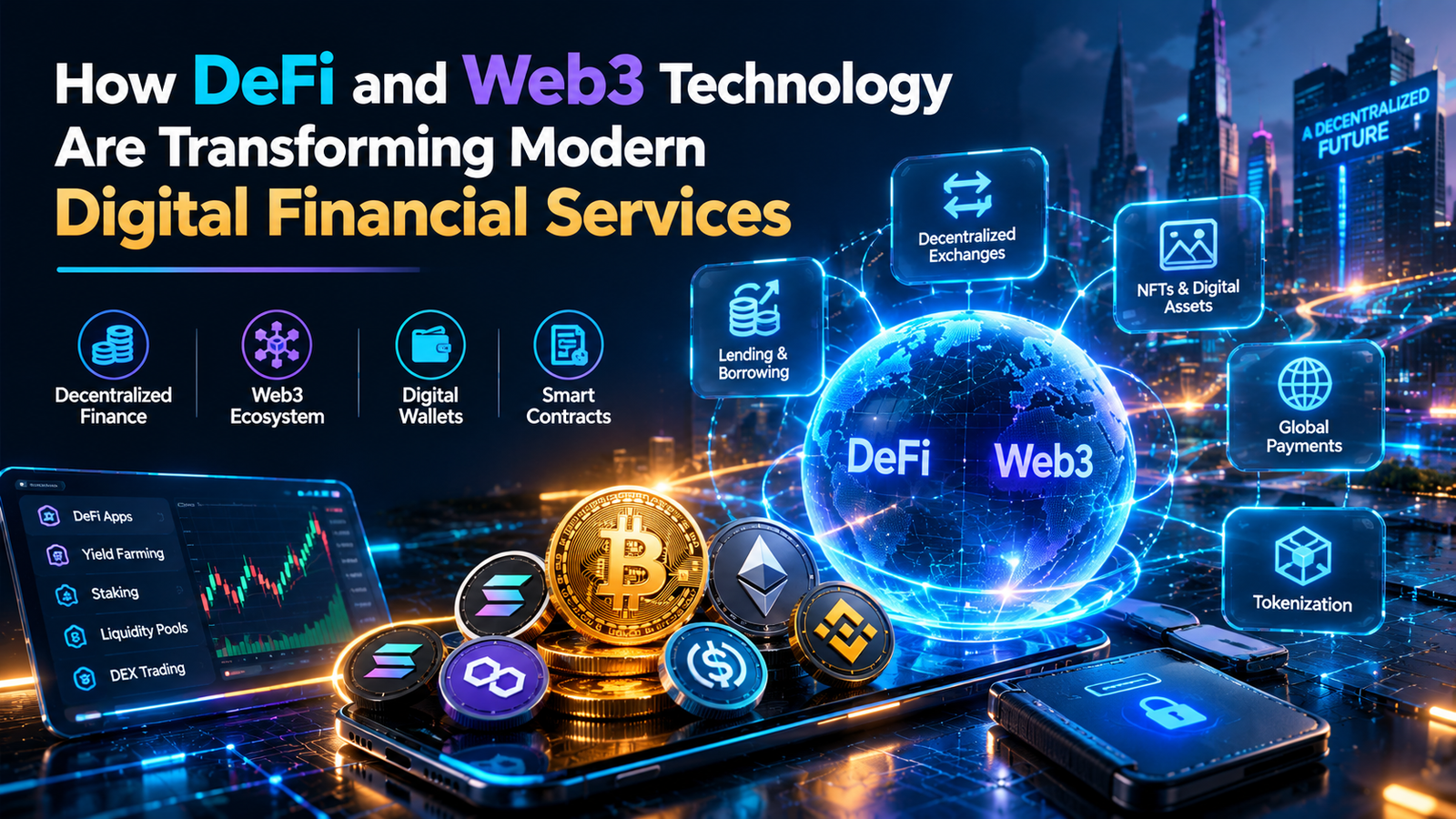
The financial industry is changing rapidly as blockchain technology introduces new ways to manage money, digital assets, transactions, and financial applications. Two of the most important concepts driving this change are DeFi and Web3. Together, these technologies are creating new approaches to financial services that can operate through decentralized networks rather than relying entirely on traditional financial institutions.
Decentralized Finance (DeFi) focuses on providing financial services through blockchain-based applications and smart contracts. Web3, on the other hand, represents a broader vision of a decentralized internet where users can interact with applications, digital assets, and online services while having greater control over their digital ownership and identity.
Understanding how DeFi and Web3 technology are transforming modern digital financial services can help beginners understand the future direction of blockchain-based finance and the opportunities and challenges associated with this emerging ecosystem.
What Is DeFi?
DeFi stands for Decentralized Finance. It refers to a collection of blockchain-based financial applications designed to provide services such as trading, lending, borrowing, and asset management without depending entirely on traditional intermediaries.
Traditional financial services usually involve banks, brokers, payment companies, and other centralized organizations. These institutions can manage accounts, approve transactions, provide loans, and maintain financial records.
DeFi uses blockchain networks and smart contracts to automate many of these functions.
Instead of a bank controlling a financial service, a decentralized application may use publicly verifiable smart contracts to execute predefined rules.
Common DeFi services include:
- Decentralized exchanges
- Crypto lending and borrowing
- Digital asset management
- Stablecoin applications
- Liquidity platforms
- Blockchain-based payments
- Decentralized financial markets
The exact features and risks differ between individual DeFi platforms.
What Is Web3?
Web3 is a broader concept related to the development of a more decentralized and user-focused internet.
Traditional online platforms often depend on centralized companies to store data, manage accounts, and control digital services. Web3 applications attempt to use technologies such as blockchain, smart contracts, and digital wallets to create alternative models.
Web3 can include:
- Decentralized applications
- Blockchain-based digital assets
- Smart contracts
- Digital wallets
- Tokenized assets
- Decentralized identity concepts
- Decentralized communities
- Blockchain-based financial applications
DeFi can therefore be considered one important part of the broader Web3 ecosystem.
How DeFi and Web3 Are Connected
DeFi and Web3 have a strong relationship because both rely on blockchain-based infrastructure.
Web3 provides a broader environment for decentralized applications and digital ownership, while DeFi focuses specifically on financial activities.
For example, a Web3 user may connect a digital wallet to a decentralized application. That application could provide a DeFi service such as token swapping or lending.
Smart contracts can then execute transactions according to programmed rules.
This connection allows financial services to become integrated with other blockchain-based applications.
How DeFi Is Changing Digital Financial Services
DeFi is introducing several new approaches to financial services.
1. Decentralized Trading
Traditional cryptocurrency trading usually takes place through centralized exchanges. Users deposit assets into an account controlled by the exchange and then place trades through its platform.
Decentralized exchanges, commonly called DEXs, operate differently.
A decentralized exchange can allow users to interact directly with blockchain-based smart contracts. Depending on the platform, users may retain control of their assets until a transaction is executed.
This model can reduce reliance on a centralized intermediary for certain types of digital asset trading.
2. Blockchain-Based Lending
Traditional lending generally requires financial institutions to evaluate borrowers and manage loan agreements.
DeFi lending platforms can use smart contracts to manage lending and borrowing activities.
Users may supply digital assets to a lending protocol, while other users can borrow assets according to the protocol’s rules.
Interest rates and collateral requirements may be determined through automated mechanisms.
This creates a different model of lending based on blockchain infrastructure.
3. Automated Financial Transactions
One of the most important characteristics of DeFi is automation.
Smart contracts are programs stored on blockchain networks that execute predefined instructions when their conditions are met.
For example, a smart contract may be designed to exchange one digital asset for another according to specific rules.
Automation can reduce the need for manual processing in certain financial activities.
The Role of Smart Contracts
Smart contracts are a fundamental part of both DeFi and Web3.
A smart contract is essentially computer code deployed on a blockchain. It can contain rules that determine how a particular application operates.
For example, a financial smart contract may define:
- How assets are deposited
- How transactions are processed
- How fees are calculated
- How rewards are distributed
- What conditions trigger a transaction
Because the rules are recorded on a blockchain, users can often inspect the contract and transaction activity.
However, smart contracts are not automatically safe simply because they operate on a blockchain. Coding errors, vulnerabilities, and poorly designed protocols can create significant risks.
How Web3 Can Improve Digital Ownership
Another important feature of Web3 is digital ownership.
Traditional internet services generally store digital information and accounts on centralized servers. Web3 applications can use blockchain networks to represent ownership through cryptographic wallets and tokens.
Digital assets can represent different forms of ownership or utility.
For example, blockchain-based tokens may represent:
- Digital collectibles
- Access rights
- Governance participation
- In-game assets
- Financial assets
- Memberships
The actual legal meaning of token ownership can vary depending on the asset and jurisdiction.
The Importance of Digital Wallets
Digital wallets are an important gateway to the Web3 ecosystem.
Unlike a traditional bank account, a blockchain wallet generally interacts directly with blockchain networks. Users can use wallets to hold or control cryptographic assets and connect to decentralized applications.
Wallets may be available as:
- Browser-based wallets
- Mobile applications
- Desktop software
- Hardware devices
Security is extremely important because users are responsible for protecting their private keys or recovery information.
A lost or compromised private key can result in permanent loss of access to assets.
DeFi and Financial Accessibility
One frequently discussed benefit of DeFi is the possibility of making certain financial services accessible through an internet connection and compatible digital wallet.
Traditional financial services may involve geographic restrictions, account requirements, business hours, or intermediary processes.
Blockchain applications can operate continuously because blockchain networks are generally available around the clock.
However, accessibility does not mean that every DeFi application is suitable for every user. Technical complexity, transaction fees, regulatory requirements, liquidity limitations, and financial risks can still create barriers.
DeFi and Global Digital Payments
Blockchain technology can also support new approaches to digital payments.
Cryptocurrencies and stablecoins can be transferred between compatible blockchain addresses without requiring the same infrastructure used by traditional banking systems.
Stablecoins are digital tokens designed to maintain a relatively stable value, often by referencing a fiat currency or other assets.
They have become an important component of many blockchain financial applications because they can provide a digital representation of value that is less volatile than many other cryptocurrencies.
The stability mechanism and risks differ significantly between stablecoins, so users should understand how a particular stablecoin is designed.
Tokenization of Real-World Assets
Web3 and DeFi are also contributing to interest in asset tokenization.
Tokenization involves representing ownership or claims related to an asset through blockchain-based tokens.
Potential examples include:
- Real estate
- Financial securities
- Commodities
- Treasury-related assets
- Digital collectibles
- Other forms of value
Tokenization can potentially make certain assets easier to transfer, track, or integrate with blockchain applications.
However, putting an asset on a blockchain does not automatically change the underlying legal ownership structure. Regulatory and legal frameworks remain important.
DeFi and Traditional Finance
DeFi does not necessarily mean that traditional financial institutions will disappear.
Instead, the financial industry may develop a combination of traditional and blockchain-based systems.
Banks and financial companies can potentially use blockchain technology for areas such as:
- Digital settlement
- Asset tokenization
- Payments
- Record keeping
- Automated financial processes
- Digital identity systems
This could result in a financial ecosystem where centralized and decentralized technologies coexist.
Advantages of DeFi and Web3
DeFi and Web3 provide several potential advantages.
Transparency
Blockchain transactions can often be publicly verified. This can provide a higher level of transaction visibility compared with systems where records are controlled entirely by a private organization.
Automation
Smart contracts can automate predefined processes, reducing the need for manual intervention in some applications.
Global Accessibility
Many blockchain applications are accessible internationally where the relevant infrastructure and regulations permit their use.
Digital Ownership
Web3 can provide users with blockchain-based mechanisms for controlling digital assets through cryptographic wallets.
Programmability
Blockchain networks can support programmable applications that combine financial functions with other digital services.
Challenges of DeFi and Web3
Despite their potential, DeFi and Web3 also face important challenges.
Smart Contract Vulnerabilities
A coding error or security vulnerability can potentially cause users to lose assets.
Market Volatility
Many digital assets can experience significant price fluctuations. This can create substantial financial risk.
High Transaction Costs
Depending on the blockchain network, transaction fees can increase during periods of high network activity.
Technical Complexity
Wallets, private keys, smart contracts, network fees, and blockchain transactions can be difficult for beginners to understand.
Regulatory Uncertainty
Governments and financial regulators around the world continue to develop rules related to cryptocurrencies, digital assets, and decentralized financial services.
Scams and Fraud
The rapid growth of Web3 has attracted fraudulent projects, phishing attacks, fake applications, and other scams.
Users should verify websites, applications, contracts, and project information carefully.
The Role of Decentralized Applications
Decentralized applications, often called dApps, are software applications that use blockchain infrastructure.
Unlike traditional applications that rely primarily on centralized servers, dApps can use smart contracts and decentralized networks for important functions.
DeFi applications are one of the most common categories of dApps.
Other Web3 applications can focus on:
- Gaming
- Digital collectibles
- Social platforms
- Identity
- Governance
- Marketplaces
- Creator economies
This demonstrates that Web3 extends beyond cryptocurrency trading and financial services.
How DeFi and Web3 May Shape the Future
The future development of DeFi and Web3 will depend on several factors.
Technology will continue to improve as developers work on scalability, security, usability, and interoperability.
Regulation will also play an important role. Clear rules could help businesses and users understand how blockchain-based financial services can operate legally.
User experience is another major factor. For Web3 to reach a wider audience, blockchain applications need to become easier and safer to use.
Future financial systems may combine blockchain technology with existing financial infrastructure rather than replacing traditional finance completely.
DeFi and Web3 for Beginners
Beginners should approach DeFi and Web3 as a technology and financial ecosystem that requires careful research.
A good starting point is learning basic concepts such as:
- Blockchain technology
- Bitcoin and other cryptocurrencies
- Digital wallets
- Private and public keys
- Smart contracts
- Decentralized applications
- Stablecoins
- Decentralized exchanges
- Tokenization
- Blockchain security
Understanding these concepts can make it easier to evaluate new Web3 applications.
Beginners should also avoid making decisions based solely on social media hype or promises of guaranteed returns.
Frequently Asked Questions
What is DeFi in simple terms?
DeFi, or decentralized finance, refers to blockchain-based financial applications that can provide services such as trading, lending, borrowing, and asset management through smart contracts.
What is Web3 in simple terms?
Web3 is a broad concept for a more decentralized internet that uses technologies such as blockchain, digital wallets, tokens, smart contracts, and decentralized applications.
Is DeFi part of Web3?
Yes. DeFi is generally considered one of the major application areas within the broader Web3 ecosystem.
How do smart contracts support DeFi?
Smart contracts contain programmed rules that can automatically execute certain transactions and financial processes on a blockchain.
Can DeFi replace banks?
It is too early to say that DeFi will completely replace traditional banks. More realistically, decentralized and traditional financial technologies may continue to develop alongside each other.
Is Web3 only about cryptocurrency?
No. Cryptocurrency is an important part of Web3, but Web3 can also include decentralized applications, digital ownership, gaming, identity, tokenization, social platforms, and other blockchain-based services.
Is DeFi safe for beginners?
DeFi carries significant risks, including smart contract vulnerabilities, market volatility, scams, liquidity issues, and loss of wallet access. Beginners should learn how the technology works before using financial applications.
Final Thoughts
How DeFi and Web3 technology are transforming modern digital financial services is an important topic for anyone interested in the future of blockchain and digital finance.
DeFi is creating alternative approaches to financial services such as trading, lending, borrowing, payments, and asset management. Web3 expands this concept by introducing a broader decentralized digital environment where users can interact with applications and digital assets through blockchain technology.
The combination of smart contracts, decentralized applications, digital wallets, tokenization, and blockchain networks could continue to influence the development of financial technology.
However, innovation also comes with challenges. Security vulnerabilities, market volatility, regulatory uncertainty, technical complexity, and scams remain important considerations.
For beginners, the best approach is to focus on education first. Understanding how blockchain networks, wallets, smart contracts, DeFi protocols, and Web3 applications work can provide a stronger foundation for evaluating this rapidly developing technology.
As blockchain infrastructure continues to evolve, DeFi and Web3 may become increasingly connected with both digital and traditional financial systems. Their long-term impact will depend on technological development, regulatory frameworks, security improvements, and real-world adoption.