
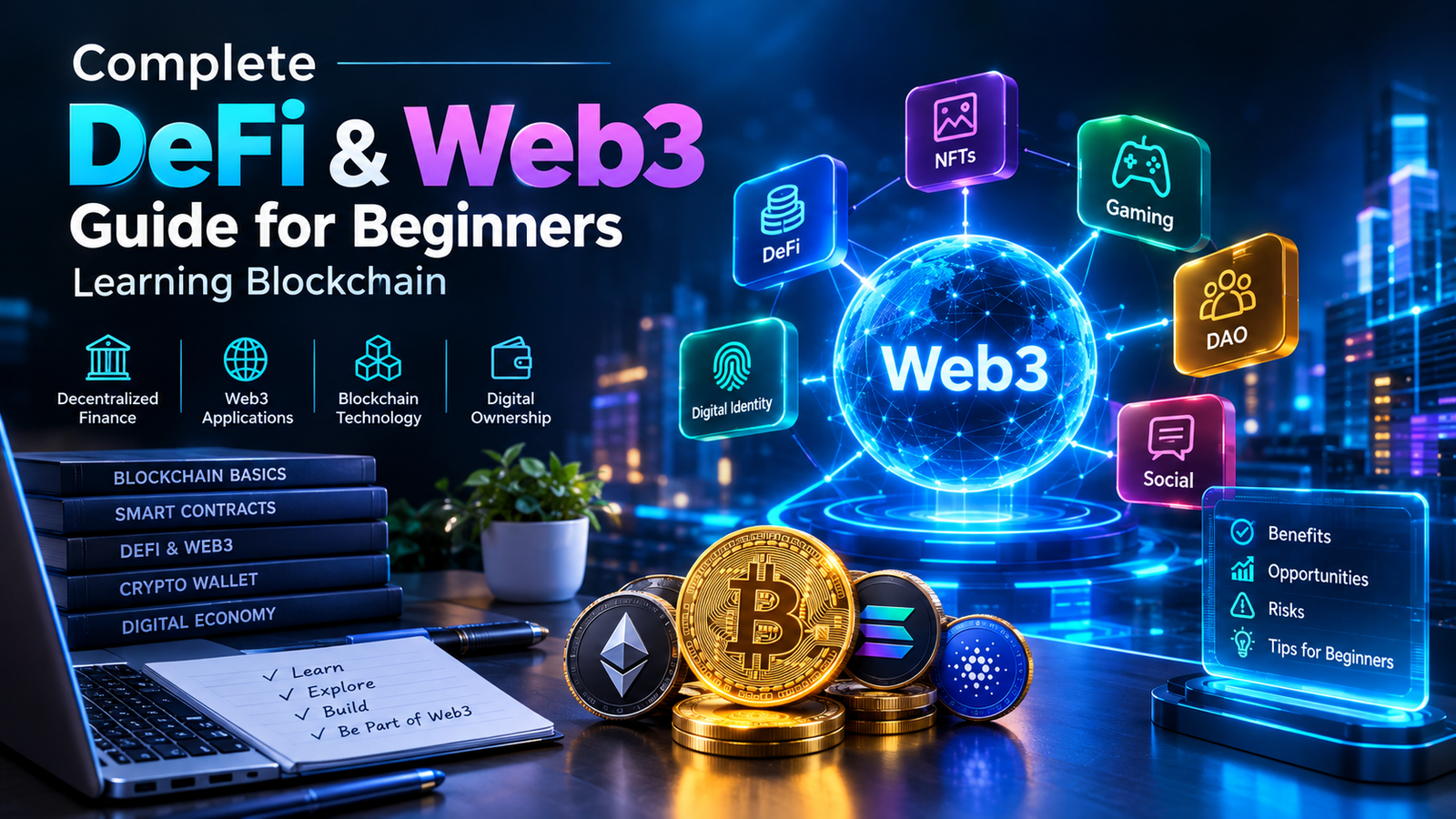
The blockchain industry has grown far beyond digital currencies. Today, concepts such as DeFi and Web3 are becoming important parts of the decentralized technology ecosystem. For beginners, however, these terms can seem confusing because they involve blockchain networks, smart contracts, digital assets, decentralized applications, and new ways of interacting with online services.
This Complete DeFi and Web3 guide for beginners learning blockchain explains these concepts in simple language. You will learn what DeFi and Web3 mean, how they work, their major features, common applications, benefits, risks, and the basic concepts beginners should understand before exploring this rapidly developing technology.
What Is DeFi?
DeFi stands for Decentralized Finance. It refers to financial services and applications built using blockchain technology and smart contracts.
Traditional financial services generally depend on centralized organizations to manage transactions, accounts, lending, payments, and other activities. DeFi attempts to provide some of these functions through decentralized blockchain-based systems.
Instead of relying entirely on a traditional intermediary, DeFi applications can use smart contracts to automatically execute predefined rules.
Common DeFi applications include:
- Decentralized exchanges
- Crypto lending platforms
- Borrowing protocols
- Liquidity pools
- Stablecoin applications
- Yield-related protocols
- Decentralized asset management
- On-chain financial tools
The goal of DeFi is to make financial applications more programmable, accessible, and decentralized.
What Is Web3?
Web3 is a broader concept than DeFi.
Web3 generally describes an internet ecosystem that makes greater use of decentralized technologies such as blockchains, smart contracts, digital assets, and decentralized applications.
Traditional websites and online services often depend on centralized companies and servers. Web3 applications can use blockchain networks to give users more direct control over digital assets and certain types of online activity.
Web3 can include areas such as:
- Decentralized applications
- Digital ownership
- Blockchain gaming
- Digital collectibles
- Decentralized finance
- Token-based communities
- Decentralized identity concepts
- Blockchain infrastructure
In simple terms, DeFi focuses mainly on decentralized financial services, while Web3 describes a broader vision for decentralized internet applications and digital ownership.
DeFi vs Web3: What Is the Difference?
Understanding the difference between DeFi and Web3 is important for beginners.
DeFi is a part of the larger Web3 ecosystem. Its main focus is financial services built with blockchain technology.
Web3 is much broader and can include finance, gaming, digital ownership, social applications, identity, data, and other blockchain-powered services.
Think of Web3 as a large ecosystem and DeFi as one important category within that ecosystem.
| Feature | DeFi | Web3 |
| Full form | Decentralized Finance | Decentralized Web |
| Main focus | Financial applications | Broader decentralized internet |
| Common technology | Blockchain and smart contracts | Blockchain, smart contracts, wallets, tokens |
| Examples | Lending, swapping, liquidity pools | dApps, gaming, digital ownership, DeFi |
| Main objective | Decentralized financial services | Greater decentralization and digital ownership |
How Does DeFi Work?
DeFi applications typically operate through blockchain networks and smart contracts.
A smart contract is a program stored on a blockchain that can automatically execute specific instructions when predefined conditions are met.
For example, a decentralized lending protocol can use smart contracts to manage deposits, loans, collateral, and repayments according to its programmed rules.
The process can look like this:
- A user connects a compatible crypto wallet.
- The user interacts with a DeFi application.
- The requested transaction is submitted to a blockchain network.
- A smart contract processes the transaction according to its rules.
- The blockchain records the resulting transaction.
This automated process reduces the need for some traditional intermediaries.
However, smart contracts are software, and software can contain bugs or vulnerabilities. Decentralization does not automatically eliminate risk.
What Are Smart Contracts?
Smart contracts are one of the most important concepts in both DeFi and Web3.
A smart contract is blockchain-based code that performs actions according to programmed conditions.
For example, a smart contract might be designed to:
- Transfer digital assets
- Manage lending rules
- Process token swaps
- Distribute rewards
- Control access to blockchain applications
- Manage decentralized organizations
Smart contracts allow blockchain applications to operate in a more automated way.
For beginners, it is useful to remember that smart contracts are not traditional legal contracts. They are software programs that execute programmed instructions on a blockchain.
What Are Decentralized Applications?
Decentralized applications are commonly called dApps.
A dApp is an application that uses blockchain technology for some part of its functionality. Unlike traditional applications that may rely entirely on centralized servers, dApps can interact with blockchain networks through smart contracts.
Users typically connect a cryptocurrency wallet to interact with a dApp.
Depending on its purpose, a dApp may allow users to:
- Trade digital assets
- Lend or borrow assets
- Play blockchain-based games
- Manage digital collectibles
- Participate in decentralized communities
- Use financial services
- Interact with blockchain-based applications
The level of decentralization can vary between different applications.
What Is a Crypto Wallet?
A cryptocurrency wallet is an important tool for interacting with many Web3 and DeFi applications.
A wallet can help users manage blockchain addresses and interact with digital assets. Wallets may exist as browser extensions, mobile applications, hardware devices, or other forms.
A wallet generally involves two important concepts:
Public Address
A public address can be shared with others when receiving supported digital assets.
Private Key
A private key is highly sensitive information that provides control over assets associated with a blockchain address.
A recovery or seed phrase can also provide access to a wallet. It should be protected carefully and never shared with strangers.
One of the biggest responsibilities in Web3 is managing wallet security.
What Are Decentralized Exchanges?
A decentralized exchange, commonly called a DEX, allows users to trade digital assets through blockchain-based protocols.
Unlike traditional centralized exchanges, decentralized exchanges can allow users to interact directly with smart contracts using their own wallets.
Many DEXs use liquidity pools rather than a traditional order-book system.
Users may be able to swap one digital asset for another without depositing assets into a centralized trading account.
However, decentralized exchanges can involve risks such as smart contract vulnerabilities, price volatility, transaction fees, and liquidity-related risks.
What Are Liquidity Pools?
Liquidity pools are collections of digital assets deposited into a smart contract.
They are commonly used by decentralized exchanges to facilitate token swaps.
For example, a liquidity pool may contain two different digital assets. Users can trade against the pool, while liquidity providers may receive fees or other incentives depending on the protocol.
Providing liquidity can generate potential returns, but it also introduces risks.
One important concept is impermanent loss, which can occur when the relative prices of assets in a liquidity pool change significantly.
Beginners should understand the risks before providing liquidity.
What Is DeFi Lending?
DeFi lending allows users to deposit digital assets into blockchain-based lending protocols.
Depending on the protocol, deposited assets can be made available to borrowers. Smart contracts can manage collateral requirements, interest calculations, and other rules.
DeFi lending can provide an alternative to traditional lending models.
However, users need to understand that cryptocurrency lending involves risks. Changes in asset prices, protocol vulnerabilities, liquidation mechanisms, and market conditions can affect users.
What Is DeFi Borrowing?
DeFi borrowing generally requires users to provide collateral before receiving a loan.
For example, a user might deposit one digital asset as collateral and borrow another asset.
Many DeFi lending systems are designed to be overcollateralized. This means the value of the collateral can be higher than the amount borrowed.
If the collateral value falls below a required threshold, the position may be subject to liquidation according to the protocol’s rules.
Understanding collateral ratios and liquidation conditions is essential before using DeFi borrowing platforms.
What Are Stablecoins?
Stablecoins are digital assets designed to maintain a relatively stable value compared with a reference asset, often a fiat currency.
They are widely used across the DeFi ecosystem because they can provide a digital asset with less price volatility than many other cryptocurrencies.
Stablecoins may be backed or supported through different mechanisms.
However, the term “stable” does not mean risk-free. Users should understand how a particular stablecoin maintains its value and what risks may affect it.
What Is Yield in DeFi?
The term yield generally refers to returns generated from a DeFi activity.
Depending on the protocol, users may potentially earn returns through:
- Lending
- Providing liquidity
- Staking
- Protocol incentives
- Other blockchain-based activities
High advertised yields should be treated carefully.
A very high potential return may involve significant risks, including token price declines, smart contract vulnerabilities, liquidity problems, or changes in protocol incentives.
Beginners should focus on understanding where the yield comes from rather than looking only at the percentage being advertised.
What Is Staking?
Staking is commonly associated with Proof-of-Stake blockchain networks.
In a Proof-of-Stake system, participants can help secure a network by committing or delegating supported assets according to the network’s rules.
In return, participants may receive network rewards.
Staking is different from simply holding a cryptocurrency. The exact process, lock-up conditions, penalties, and rewards depend on the blockchain network.
Before staking, users should understand the specific network’s rules and associated risks.
How Web3 Changes Digital Ownership
One of the major ideas behind Web3 is digital ownership.
Traditional digital services often store user information and digital items within centralized platforms. Web3 technologies can allow certain assets to be represented on blockchains through tokens.
This can create new approaches to:
- Digital collectibles
- Gaming assets
- Membership systems
- Token-based communities
- Digital credentials
- Blockchain-based ownership records
However, owning a token does not automatically mean owning copyright, intellectual property, or physical property. The actual rights depend on the specific project and its terms.
Web3 Gaming
Blockchain technology has also influenced the gaming industry.
Web3 games can use blockchain networks to represent certain in-game items as digital assets. In some designs, players can transfer or trade these assets outside the game’s traditional database.
Blockchain gaming can introduce concepts such as:
- Tokenized game assets
- Digital collectibles
- Player-owned items
- Token economies
- Decentralized marketplaces
The quality and usefulness of Web3 gaming projects can vary significantly, so beginners should research individual projects rather than assuming every blockchain game offers the same experience.
Benefits of DeFi and Web3
DeFi and Web3 can provide several potential advantages.
Decentralization
Blockchain-based systems can reduce reliance on a single central authority for certain activities.
Transparency
Many blockchain transactions can be publicly viewed and independently verified.
Programmability
Smart contracts allow developers to create automated financial and digital applications.
Global Accessibility
Blockchain applications can potentially be accessed by users in different regions with compatible internet access and blockchain tools.
Digital Ownership
Token-based systems can create new ways of representing digital assets and ownership records.
Innovation
DeFi and Web3 provide developers with tools for creating new financial and digital applications.
These benefits are potential advantages, not guarantees. Each project needs to be evaluated individually.
Risks of DeFi and Web3
Understanding the risks is just as important as understanding the benefits.
Smart Contract Risk
A bug or vulnerability in a smart contract can potentially result in financial losses.
Market Volatility
Digital asset prices can change rapidly.
Liquidity Risk
Some tokens and DeFi markets may have limited liquidity.
Regulatory Uncertainty
Rules surrounding digital assets and decentralized applications can change over time.
Scam Projects
The Web3 ecosystem contains fraudulent websites, tokens, applications, and investment schemes.
Wallet Security
Losing private keys or recovery phrases can result in loss of access to assets.
Phishing
Attackers may create fake websites or messages designed to steal wallet information.
Beginners should never assume that a project is safe simply because it appears popular online.
Common Web3 and DeFi Scams
Scams are an important issue for anyone entering the decentralized technology ecosystem.
Common examples include:
- Fake airdrops
- Phishing websites
- Fake wallet applications
- Impersonation accounts
- Fraudulent investment schemes
- Fake token launches
- Malicious smart contracts
- Giveaway scams
- Fake customer-support accounts
A good security habit is to verify information through official sources before connecting a wallet or approving a transaction.
Never share a private key or recovery phrase with anyone claiming to provide technical support.
How Beginners Can Start Learning DeFi and Web3
Beginners do not need to understand everything at once.
A simple learning path can make the process easier.
Step 1: Learn Blockchain Fundamentals
Start by understanding blocks, transactions, wallets, consensus mechanisms, and decentralized networks.
Step 2: Learn About Bitcoin
Understanding the first major cryptocurrency provides useful context for the development of blockchain technology.
Step 3: Understand Smart Contracts
Learn how blockchain-based programs work and why they are important for DeFi and Web3.
Step 4: Explore Ethereum and Other Smart-Contract Networks
Learn how blockchain platforms can support decentralized applications.
Step 5: Understand Wallets
Learn how public addresses, private keys, and recovery phrases work.
Step 6: Study DeFi Applications
Explore concepts such as decentralized exchanges, lending, borrowing, staking, and liquidity pools.
Step 7: Learn Web3 Use Cases
Study decentralized applications, gaming, digital ownership, and token-based communities.
Step 8: Practice Security
Learn how to identify suspicious links, fake applications, and fraudulent projects.
DeFi and Web3: Important Terms for Beginners
Here are some basic terms worth learning:
Blockchain: A distributed digital ledger that records transactions.
Smart Contract: Blockchain-based software that executes programmed instructions.
dApp: A decentralized application that uses blockchain technology.
Wallet: A tool used to manage blockchain addresses and interact with digital assets.
DEX: A decentralized exchange that allows blockchain-based asset trading.
Liquidity Pool: Digital assets deposited into a smart contract to support certain DeFi functions.
Staking: Participating in a Proof-of-Stake network according to its rules, often in exchange for rewards.
Gas Fee: A transaction fee paid to process activity on certain blockchain networks.
Token: A digital asset created and managed through blockchain technology.
DAO: A decentralized autonomous organization that uses blockchain-based mechanisms for community coordination and governance.
Learning these terms can make future blockchain research much easier.
DeFi and Web3 Security Tips for Beginners
Security should be a priority from the beginning.
Before interacting with a Web3 application, verify that you are using the correct website.
Never enter your wallet recovery phrase into a website unless you are intentionally restoring your wallet through a trusted wallet application.
Be careful when approving token transactions or smart-contract permissions. Read transaction details carefully and avoid interacting with unfamiliar applications.
It is also useful to separate experimental activity from important assets. Beginners should avoid risking money they cannot afford to lose.
Is DeFi the Same as Cryptocurrency?
No. Cryptocurrency is a broader category of digital assets, while DeFi is an ecosystem of decentralized financial applications and protocols.
Cryptocurrencies and tokens can be used within DeFi applications, but DeFi itself refers more broadly to blockchain-based financial services.
Similarly, Web3 is broader than DeFi because Web3 can include financial and non-financial blockchain applications.
Is Web3 the Future of the Internet?
Web3 represents one possible direction for the development of internet technology.
Its supporters believe decentralized systems can provide greater user control, digital ownership, transparency, and new application models.
At the same time, Web3 still faces challenges involving scalability, usability, security, regulation, infrastructure, and mainstream adoption.
Therefore, it is more accurate to view Web3 as an evolving technology ecosystem rather than assuming that it will completely replace today’s internet.
Frequently Asked Questions
What does DeFi mean?
DeFi means Decentralized Finance. It refers to blockchain-based financial applications that can provide services such as trading, lending, borrowing, and liquidity management through decentralized protocols and smart contracts.
What does Web3 mean?
Web3 is a broad concept describing an internet ecosystem that uses decentralized technologies such as blockchains, smart contracts, tokens, and decentralized applications.
Is DeFi part of Web3?
Yes. DeFi is generally considered one of the major categories within the broader Web3 ecosystem.
Do I need cryptocurrency to use Web3?
Many Web3 applications require a compatible wallet and digital assets for transactions, but the exact requirements vary depending on the application.
Is DeFi safe for beginners?
DeFi can involve significant risks. Smart contract bugs, market volatility, scams, liquidity issues, and wallet-security problems can lead to losses. Beginners should learn the fundamentals and start cautiously.
What is the most important Web3 concept to learn first?
Blockchain fundamentals are a good starting point. After that, beginners can learn wallets, private keys, smart contracts, tokens, and decentralized applications.
Final Thoughts
This Complete DeFi and Web3 guide for beginners learning blockchain provides a foundation for understanding one of the most rapidly developing areas of blockchain technology.
DeFi focuses on decentralized financial applications such as exchanges, lending, borrowing, staking, and liquidity protocols. Web3 is a broader concept that includes DeFi as well as decentralized applications, digital ownership, gaming, token-based communities, and other blockchain-powered experiences.
For beginners, the best approach is to learn gradually. Start with blockchain fundamentals, understand wallets and smart contracts, explore DeFi concepts, and then investigate broader Web3 applications.
Most importantly, education and security should come before financial decisions. Cryptocurrency and blockchain technologies can offer innovative opportunities, but they also involve substantial risks and uncertainty. Understanding how a system works is one of the best ways to make more informed decisions in the evolving Web3 ecosystem.