
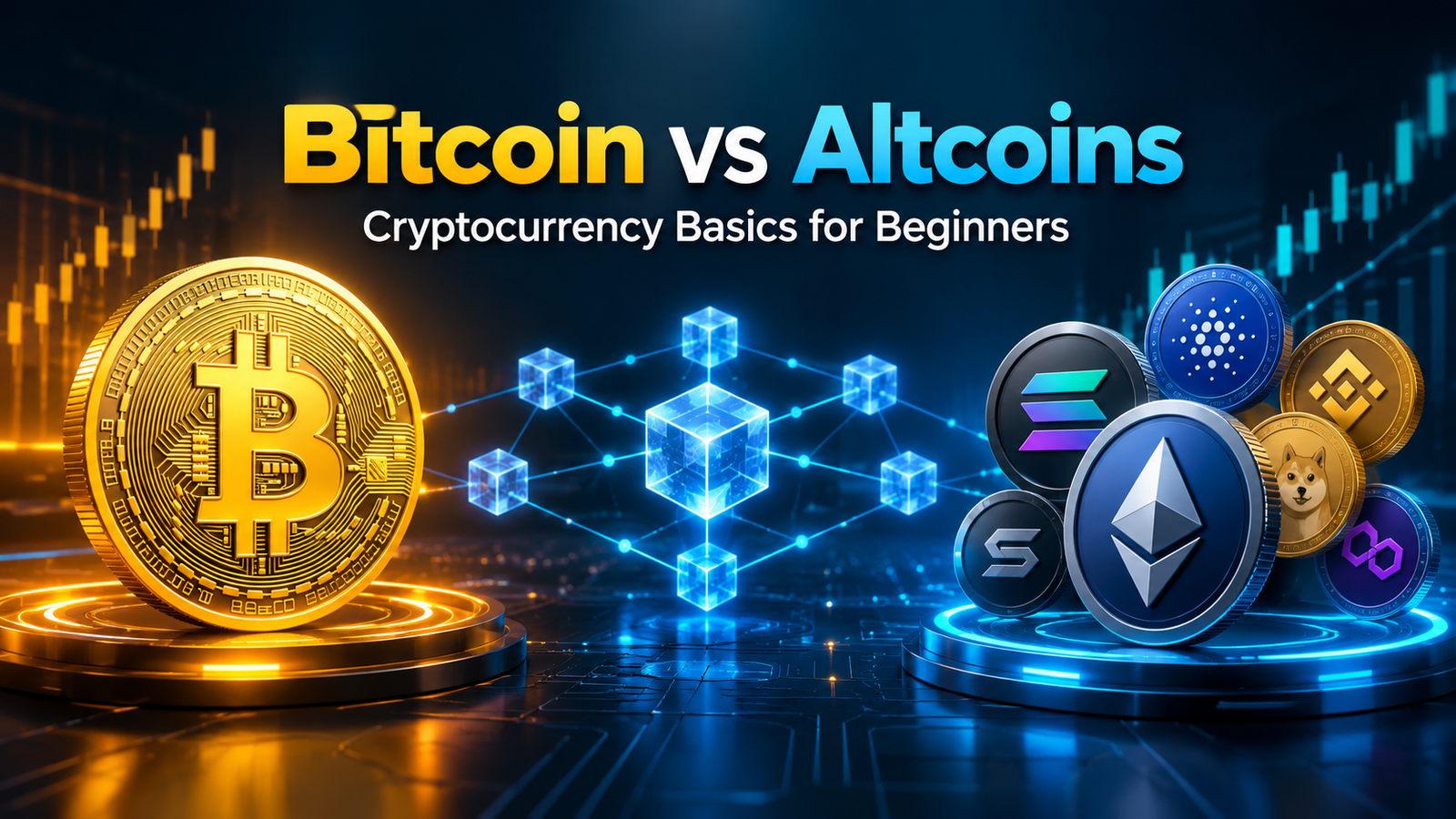
Cryptocurrency has become an important topic in the digital finance world, with Bitcoin and altcoins being two of the most commonly discussed categories. For beginners, understanding the difference between Bitcoin and altcoins can make the cryptocurrency market much easier to understand.
Bitcoin was the first major cryptocurrency and introduced the concept of decentralized digital money. Since then, thousands of other cryptocurrencies have been created with different technologies, purposes, features, and use cases. These cryptocurrencies are generally known as altcoins, meaning alternative coins to Bitcoin.
This Bitcoin and altcoins comparison for beginners explains what Bitcoin and altcoins are, how they work, their major differences, advantages, risks, and the factors beginners should understand before exploring the cryptocurrency market.
What Is Bitcoin?
Bitcoin is a decentralized digital currency introduced in 2009. It allows people to transfer value through a peer-to-peer network without relying on a traditional central authority such as a bank.
Bitcoin transactions are recorded on a public blockchain. This blockchain acts as a distributed digital ledger that helps verify and record transactions.
One of Bitcoin’s main features is its limited supply. The Bitcoin network is designed so that there can never be more than 21 million bitcoins. This limited supply is one reason Bitcoin is often described as a scarce digital asset.
Bitcoin is also widely recognized as the first successful cryptocurrency and has played a major role in the development of the broader digital asset industry.
What Are Altcoins?
The term altcoin generally refers to cryptocurrencies other than Bitcoin. Some altcoins are designed to provide features that differ from Bitcoin, while others are created for specific applications or blockchain ecosystems.
Examples of well-known altcoins include Ethereum, Solana, Cardano, and many others. Each project can have its own blockchain technology, token economics, development team, and purpose.
For example, some altcoins focus on smart contracts, decentralized applications, digital payments, gaming, decentralized finance, or other blockchain-based services.
Because there are thousands of cryptocurrencies, altcoins are not all the same. Their technology, usefulness, market size, and risk levels can vary significantly.
Bitcoin vs Altcoins: The Basic Difference
The simplest difference between Bitcoin and altcoins is that Bitcoin is the original cryptocurrency, while altcoins are alternative cryptocurrencies developed after Bitcoin.
Bitcoin primarily focuses on decentralized digital money and storing value. Many altcoins attempt to solve different problems or provide additional blockchain functionality.
Here is a simple comparison:
| Feature | Bitcoin | Altcoins |
| Launch | 2009 | Developed after Bitcoin |
| Main purpose | Digital money and value transfer | Various purposes and applications |
| Supply | Maximum 21 million | Depends on the project |
| Technology | Bitcoin blockchain | Different blockchain technologies |
| Smart contracts | Limited compared with smart-contract platforms | Many support advanced smart contracts |
| Market maturity | Generally more established | Varies widely |
| Risk | High | Can range from high to extremely high |
| Number of projects | One Bitcoin network | Thousands of different projects |
This comparison shows why beginners should not treat every cryptocurrency as identical.
Why Bitcoin Is Different From Altcoins
Bitcoin has a unique position in the cryptocurrency market because it was the first major decentralized digital currency.
Its network has been operating for many years and has become widely recognized. Bitcoin’s simple monetary purpose is also different from many newer blockchain projects.
A large number of altcoins are designed as platforms rather than simply digital currencies. These platforms may allow developers to create decentralized applications, smart contracts, financial products, games, or other blockchain-based services.
Therefore, comparing Bitcoin with altcoins is not always a simple matter of deciding which one is better. They can have completely different purposes.
Understanding Bitcoin’s Main Features
For beginners learning cryptocurrency basics, it is important to understand several important Bitcoin features.
1. Decentralization
Bitcoin operates through a decentralized network of computers. No single organization controls the entire Bitcoin network.
2. Limited Supply
Bitcoin has a maximum supply of 21 million coins. This fixed supply is one of its most well-known characteristics.
3. Blockchain Technology
Bitcoin transactions are recorded on a blockchain. The blockchain allows network participants to verify transactions without depending on a centralized database.
4. Proof of Work
Bitcoin uses a consensus mechanism called Proof of Work. Miners use computing power to help secure the network and process transactions.
5. Peer-to-Peer Transactions
Bitcoin allows users to send value directly between cryptocurrency addresses without requiring a traditional financial intermediary.
Understanding Altcoins
Altcoins can use many different technologies and consensus mechanisms.
Some altcoins use Proof of Stake, while others use different approaches. Their networks may be designed to improve transaction speed, reduce costs, support smart contracts, or provide specialized applications.
For beginners, the most important point is that the word “altcoin” covers a very large range of cryptocurrency projects.
A well-established blockchain project and an unknown token should not automatically be considered equal simply because both are altcoins.
Bitcoin and Altcoins: Use Cases
One of the most important parts of a Bitcoin and altcoins comparison is understanding their use cases.
Bitcoin is commonly associated with:
- Digital payments
- Peer-to-peer transactions
- Long-term digital asset ownership
- Store-of-value discussions
- Decentralized monetary technology
Altcoins can have many different use cases, including:
- Smart contracts
- Decentralized applications
- Decentralized finance
- Blockchain gaming
- Digital collectibles
- Payments
- Network utility
- Data and infrastructure services
The exact use case depends on the individual cryptocurrency project.
Bitcoin vs Altcoins: Technology
Technology is another major difference between Bitcoin and altcoins.
Bitcoin uses a relatively focused blockchain design intended to prioritize decentralization, security, and reliability.
Many newer blockchain projects attempt to provide additional functionality. Some are designed to process transactions faster, while others focus on smart contracts or specialized applications.
However, additional functionality can also introduce additional complexity.
Beginners should therefore understand what technology a cryptocurrency uses before forming an opinion about the project.
Bitcoin vs Altcoins: Transaction Speed
Transaction speed varies between cryptocurrency networks.
Bitcoin transactions are processed through its decentralized mining network. The time required for a transaction to receive confirmations can vary depending on network activity and transaction fees.
Some altcoins are designed to process transactions more quickly. Certain networks can provide faster confirmation times and lower transaction costs.
However, faster transactions do not automatically mean that one cryptocurrency is better. Network security, decentralization, adoption, development, and actual utility are also important factors.
Bitcoin vs Altcoins: Supply
Supply is an important part of cryptocurrency economics.
Bitcoin has a maximum supply of 21 million coins. This creates a predictable supply structure.
Altcoin supply models can be very different. Some have fixed maximum supplies, while others may have inflationary or dynamically changing supply mechanisms.
When researching an altcoin, beginners should look at:
- Maximum supply
- Circulating supply
- Total supply
- Token issuance
- Token distribution
- Inflation or burning mechanisms
Understanding supply can help beginners better understand how a cryptocurrency’s token economics work.
Bitcoin and Altcoins: Market Volatility
Cryptocurrency prices can change significantly over short periods. Bitcoin can experience substantial price movements, but smaller altcoins can sometimes experience even larger fluctuations.
Lower market capitalization cryptocurrencies may be particularly sensitive to changes in market sentiment and liquidity.
This means beginners should not assume that a low-priced coin is automatically cheaper or has greater potential.
For example, a cryptocurrency priced at a few cents can have a very large total supply. Its price alone does not tell you whether it is inexpensive or valuable.
Why Altcoins Can Be Riskier
Many altcoins are newer than Bitcoin and may have smaller communities, lower liquidity, and less established track records.
Some projects may fail to achieve their intended goals. Others may lose development activity or user interest.
There are also fraudulent tokens and projects designed to take advantage of inexperienced investors.
Before researching an altcoin, beginners should investigate the project’s:
- Official documentation
- Development activity
- Token supply
- Use case
- Blockchain technology
- Community activity
- Market liquidity
- Security history
- Team information
- Long-term development plans
Research is especially important when dealing with lesser-known cryptocurrencies.
Is Bitcoin Better Than Altcoins?
There is no universal answer to whether Bitcoin is better than altcoins.
Bitcoin and altcoins serve different purposes. Bitcoin is the original decentralized cryptocurrency and has a strong focus on digital money and scarcity.
Altcoins can offer additional functionality and may be used for specific blockchain applications.
Instead of asking which cryptocurrency is automatically better, beginners should ask:
What problem does this cryptocurrency solve?
Understanding the purpose of a cryptocurrency is more useful than judging it only by its price.
Bitcoin and Altcoins for Beginners
Someone learning cryptocurrency basics should start with fundamental concepts rather than immediately focusing on short-term prices.
A beginner-friendly learning path can include:
Step 1: Learn Blockchain Basics
Understand how blockchain networks record and verify transactions.
Step 2: Understand Bitcoin
Learn why Bitcoin was created, how transactions work, and how its supply is controlled.
Step 3: Explore Altcoins
Research how different blockchain projects differ from Bitcoin.
Step 4: Learn About Wallets
Understand the difference between cryptocurrency wallets, public addresses, and private keys.
Step 5: Understand Security
Learn about scams, phishing, fake websites, suspicious links, and the importance of protecting private keys.
Step 6: Research Before Making Decisions
Never rely solely on social media posts or online hype. Research the cryptocurrency and understand its technology and risks.
Common Mistakes Beginners Make
New cryptocurrency users often make mistakes because they focus too much on price.
Mistake 1: Buying Because the Price Is Low
A low coin price does not mean the cryptocurrency is undervalued.
Mistake 2: Following Online Hype
Social media trends can change quickly. Popularity does not guarantee a project’s long-term success.
Mistake 3: Ignoring Market Capitalization
Market capitalization provides more context than the price of one individual coin.
Mistake 4: Ignoring Token Supply
Supply plays an important role in understanding cryptocurrency economics.
Mistake 5: Not Checking the Project
Beginners should investigate a project’s purpose, technology, development, and risks.
Mistake 6: Sharing Private Information
Private keys and recovery phrases should be kept secure. They should never be shared with strangers or entered into suspicious websites.
How to Research an Altcoin
Before learning more about an altcoin, beginners can use a simple research checklist.
First, identify the project’s purpose. Ask what problem the project is trying to solve.
Next, examine the technology. Find out whether it operates on its own blockchain or another blockchain network.
Then check the tokenomics. Look at circulating supply, maximum supply, distribution, and issuance.
After that, examine development activity. A project with active development and transparent information can be easier to evaluate than one with little available information.
Finally, consider the risks. No cryptocurrency is guaranteed to succeed, and past performance does not guarantee future results.
Bitcoin and Altcoins: Security Considerations
Security is one of the most important cryptocurrency basics.
Unlike traditional online accounts, cryptocurrency transactions can be difficult or impossible to reverse. If private keys are lost or funds are sent to the wrong address, recovering the assets may not be possible.
Beginners should:
- Use strong passwords
- Enable two-factor authentication where available
- Keep recovery phrases private
- Avoid suspicious links
- Verify wallet addresses before sending funds
- Be cautious of fake investment opportunities
- Avoid sharing private keys
- Keep important wallet information securely stored
Security should be considered before buying, selling, or transferring cryptocurrency.
Bitcoin and Altcoins: Which Should Beginners Learn First?
For someone completely new to cryptocurrency, Bitcoin is usually a useful starting point because understanding Bitcoin provides a foundation for learning how decentralized digital currencies work.
After understanding Bitcoin, beginners can explore altcoins and learn why different blockchain projects were created.
This approach makes it easier to understand concepts such as smart contracts, decentralized applications, Proof of Stake, tokenomics, and blockchain ecosystems.
The goal should be education rather than simply following the latest cryptocurrency trend.
Frequently Asked Questions
What is the difference between Bitcoin and altcoins?
Bitcoin is the original cryptocurrency launched in 2009. Altcoins are cryptocurrencies other than Bitcoin. Altcoins can have different technologies, purposes, supply models, and use cases.
Are altcoins cryptocurrencies?
Yes. Altcoins are generally cryptocurrencies other than Bitcoin.
Is Bitcoin an altcoin?
No. Bitcoin is not considered an altcoin. The term altcoin refers to alternative cryptocurrencies other than Bitcoin.
Are altcoins riskier than Bitcoin?
Many altcoins can carry higher risks because they may have smaller markets, shorter histories, lower liquidity, or less established technology. However, risk varies significantly between individual projects.
Why were altcoins created?
Altcoins were created for many different reasons. Some attempt to improve blockchain functionality, while others focus on smart contracts, payments, decentralized applications, gaming, finance, or other use cases.
Should beginners buy Bitcoin or altcoins?
There is no single answer for everyone. Beginners should first understand cryptocurrency technology, research individual projects, and consider the risks before making financial decisions.
Can an altcoin become more valuable than Bitcoin?
An individual altcoin can increase significantly in price, but price comparisons alone can be misleading because cryptocurrency supply differs between projects. Market capitalization and tokenomics are important factors to consider.
Final Thoughts
Understanding the difference between Bitcoin and altcoins is one of the first important steps for anyone learning cryptocurrency basics.
Bitcoin introduced a decentralized form of digital money and remains a major part of the cryptocurrency ecosystem. Altcoins expanded the concept by introducing different blockchain technologies, applications, consensus mechanisms, and use cases.
The biggest lesson for beginners is that Bitcoin and altcoins are not interchangeable. Each cryptocurrency should be evaluated based on its technology, purpose, adoption, supply, development, security, and risks.
Instead of focusing only on price or online hype, beginners should take time to understand how cryptocurrency works. Learning blockchain fundamentals, researching individual projects, and following good security practices can provide a much stronger foundation for navigating the digital asset market.
Cryptocurrency can offer interesting technological possibilities, but it also involves significant uncertainty and risk. Education and careful research are therefore essential before making any financial decision.